Why the John Deere 3 Series is the Sweet Spot for Small Farms
12/2/2025
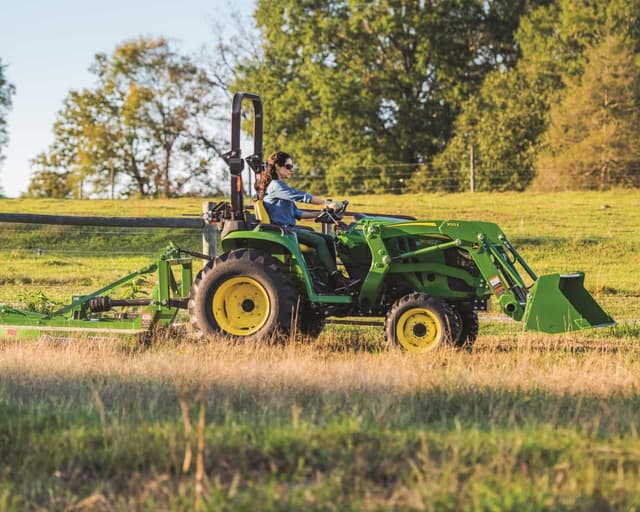
Many small farmers end up choosing between a compact tractor that’s too small or a utility tractor that’s far too big. Here’s the good news: John Deere’s 3 Series is designed to bridge the gap, offering plenty of power and efficiency in a compact package that fits in your standard garage. Here, we’re breaking down what makes the 3 Series perfect for small farms in Mississippi.
30-50 horsepower is a practical range for most small, mixed farming operations. Below 30 horsepower, you can mow and do light loader work, but the heavy clay soils in Mississippi usually require a little more power. Above 50, you’re likely buying more power than you really need unless you’re running a larger row crop or hay operation.
Ranging from 25-39 horsepower, John Deere’s 3 Series fits the sweet spot. For diverse operations including tilling, mowing, loader work, rotary cutting, and more, the 3032E and 3038E are where most farmers land.
3 Series models run a hydrostatic transmission with TwinTouch foot pedals, meaning you can quickly change direction without ever touching a clutch. If you’re working in tight spaces like smaller farms often require, that responsiveness adds up.
Select models feature LoadMatch, which lowers ground speed when the engine load is increased. This boosts fuel efficiency and lowers engine strain.
The 300E loader–compatible with all 3 Series models–lives 845 pounds. That’s enough for small hay bales, manure spreading, palletized feed, and general material handling. Four-wheel drive keeps traction when conditions turn slippery or the slope gets serious–two basic features of a Mississippi farm.
On a small farm, you’re probably running many operations, from cattle and pasture maintenance to hay production and road grading. That’s a lot of implements to cycle through in just a day’s work. The 3 Series is designed to handle rotary cutters, rotary tillers, box blades, rear blades, and small square bale hay equipment, and more. iMatch Quick-Hitch compatibility makes switching implements fast, which matters when morning chores and afternoon field work require completely different setups.
It makes sense for farms ranging from 10-50 acres with diversified operations, regular implement use, pasture and food plot management, and moderate loader work.
If your operation is primarily residential with occasional farm tasks, is under 10 acres, or doesn't involve regular ground-engaging implements, the 2 Series will cover what you need at a lower cost. If you're pushing past 50 acres with intensive cultivation, running a large round baler, or regularly pulling implements that need 45+ PTO horsepower, consider looking at the 4 Series or larger.
Small farm operations require sufficient horsepower–usually 20-50. With the 3 Series, you’re not overpaying for capacity you'll never use, and you're not limping through farm work with underpowered equipment.
Contact your local WADE, Inc. to discuss your specific farming operations. Our experts are here to consider details like acreage, your typical tasks, required implements, and more, to get you a straight answer–whether that’s the 3 Series or not.