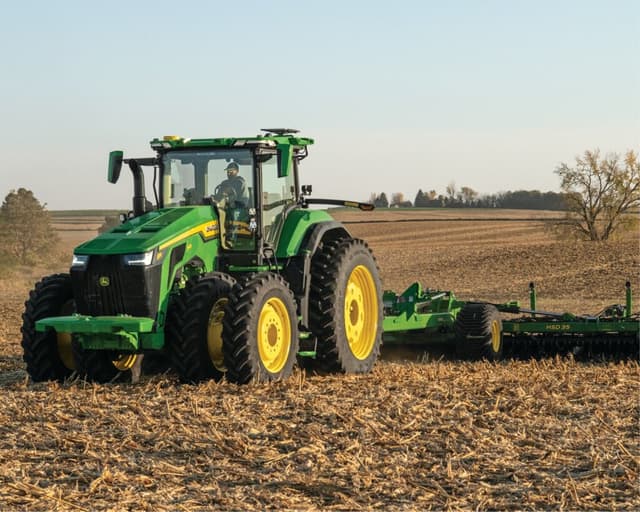
Cover cropping is one of the most effective tools a Mississippi farmer has for managing soil health between production seasons. A well-timed summer cover crop like cowpeas, sorghum-sudangrass, or sunn hemp, will help to suppress weeds, fix nitrogen, control erosion, and build organic matter in your soil.
The challenge is execution. Mississippi summers are hot, humid, and unforgiving. Your planting window is narrow, your fields are large, and the work needs to happen fast. For large ag operations, the right equipment isn't just about convenience—it's about covering your acreage in time to make cover cropping economically viable.
On large Mississippi row crop acres, termination typically happens chemically ahead of cover crop seeding, but if you're managing heavy residue from a corn or sorghum crop, a vertical tillage pass helps manage that material before seeding. John Deere's 2660VT variable intensity tiller works residue into the top few inches of soil without full inversion, preserving moisture and keeping your planting window tight. On fields with lighter residue crops like cotton and soybeans, chemical termination alone is often sufficient.
Mississippi's heavy clay soils compact under heavy equipment traffic and summer heat. Whether you're seeding into a prepared seedbed or managing a no-till system, surface conditions directly affect germination rates.
For large-scale operations, vertical tillage strikes the right balance between residue management and field efficiency. The John Deere 2660VT moves fast and covers ground without the fuel cost or time investment of conventional tillage. This is critical when you're working against a narrow mid-summer planting window across hundreds of acres.
If your operation uses strip-till on cash crops, consider carrying that system into your cover crop seeding. Strips maintain soil structure between rows while giving cover crop seed a prepared zone for establishment. In Mississippi's poorly draining soils, this approach helps manage compaction in high-traffic zones without disturbing the entire field.
At the scale of large ag, seeding method determines how fast you can cover ground and how well your stand establishes. Two approaches dominate on Mississippi row crop operations:
John Deere's ExactEmerge and MaxEmerge planter platforms can be adapted for cover crop species with the right seed disc and meter configurations. If your planter is already set up for your cash crop rotation, adapting it for cover crop seeding gives you precise depth control and excellent seed-to-soil contact—two factors that matter most in Mississippi's summer heat.
For operations covering large acreage quickly, an air seeder or commodity air system mounted to a toolbar broadcasts seed efficiently across wide swaths. Many large Mississippi operations aerial seed cover crops into standing soybeans in late summer—a method that works well for smaller-seeded species like sorghum-sudangrass when timed correctly ahead of canopy closure.
A grain drill with small seed capability remains the most reliable option for precise seeding depth and strong stand establishment. On fields with significant slope or erosion history, the drill's soil contact advantage over broadcast seeding is worth the slower ground speed.
On large acreage, the post-seeding pass is easy to skip. But it’s often costly to skip, too. If you broadcast-seeded, a cultipack pass firms the seedbed and pushes seed into soil contact. In Mississippi's unpredictable summer, where dry windows between rain events can stretch for weeks, that contact is what separates a 60% stand from a 90% stand.
Most summer cover crops in Mississippi need to be in the ground between late May and mid-July. On a large operation, that means planning your equipment availability well ahead of cash crop harvest—especially if you're seeding cover crops into standing beans or sequencing immediately behind wheat harvest. The operations that consistently establish strong cover crops are the ones that treat the planting window with the same urgency as cash crop planting.
Whether you're adapting your existing John Deere planter platform, looking at vertical tillage options, or pricing out a drill for dedicated cover crop seeding, your local WADE, Inc. team can help you build an efficient system for your operation's scale and rotation.
The best method depends on your acreage and equipment. John Deere's ExactEmerge and MaxEmerge planter platforms offer precise depth control for adapted cover crop seeding, air seeders cover large acreage quickly, and a grain drill with small seed capability remains the most reliable option for stand establishment on erosion-prone fields.
Most summer cover crops in Mississippi need to be in the ground between late May and mid-July. Operations that treat this window with the same urgency as cash crop planting consistently establish the strongest stands.
Not always, but surface conditions directly affect germination rates in Mississippi's heavy clay soils. For operations managing heavy residue from corn or sorghum, a vertical tillage pass with the John Deere 2660VT helps incorporate material without full inversion, while lighter residue crops like cotton and soybeans can often go straight to chemical termination and seeding.