
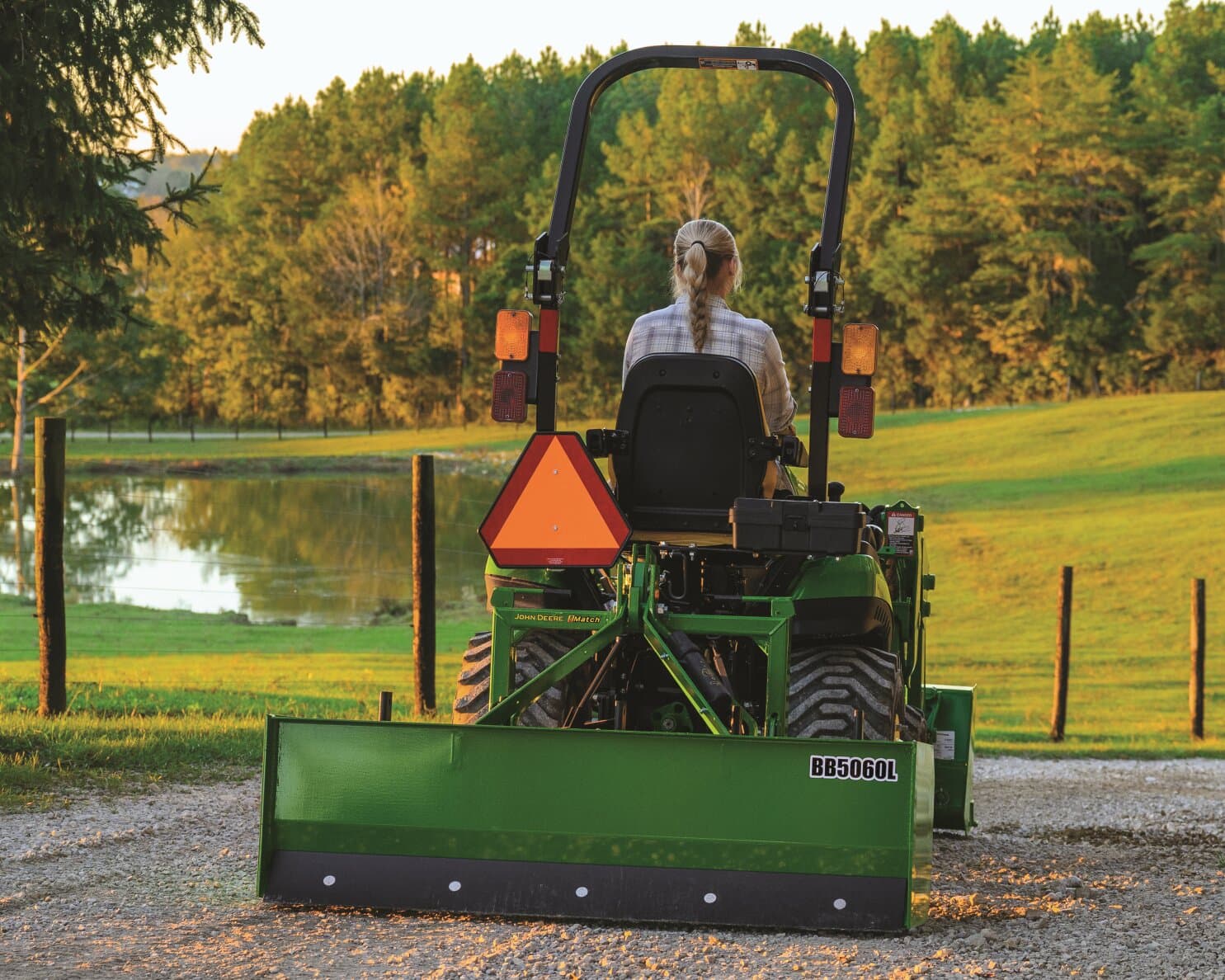
How to Grade a Gravel Driveway with a John Deere Compact Tractor
4/3/2026
Spring rain does a number on gravel driveways across Mississippi. Between heavy downpours and a season of freeze-thaw cycles, gravel migrates, ruts form, and low spots allow water to pool. By the time April rolls around, a driveway that was fine last fall can be a mess.
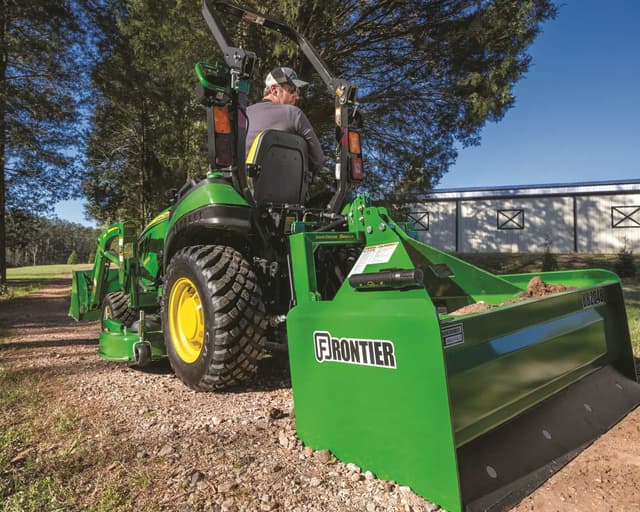
Here’s the good news: if you own a John Deere compact tractor, you’re already on your way to fixing the problem! Here’s WADE, Inc.’s practical guide to grading your gravel driveway using only a box blade.
It’s easy to forget this step, but it’s important to wait for optimal working conditions. Grading a driveway before it’s dry doesn’t work. You’ll only be moving mud around and creating more ruts. In Mississippi’s rainy spring, patience is key. Wait until the surface has tried enough to support your tractor’s weight without sinking.
Before you hitch up the box blade, walk your driveway and answer a few questions:
The answers to these questions will tell you where to push material from and where it needs to go. Grading a driveway isn’t just dragging a blade from one end to the other. You’ll need to redistribute gravel from high areas to low spots, and add gravel where you’ve lost too much material.
A box blade has three main adjustment points: cutting edge angle, depth of cut, and the scarifier teeth on the front. For gravel driveway grading, here's how to set up:
Lower the scarifier teeth for your first pass. These break up compacted material and loosen displaced gravel so your box blade can move it effectively. If your driveway has firm ruts or hardened high spots, the scarifier makes your blade work far more efficiently.
Set your blade at a slight angle to push material toward the crown of the driveway. A properly crowned driveway sheds water to the sides while flat or dipped driveways hold water in the center and accelerate deterioration.
Start shallow. A cutting depth of 1-2 inches is typically sufficient for spring cleanup work. Going too deep on a first pass pulls up base material and makes grading less efficient.
Work your driveway in passes along its length. Start at one edge and work toward the center, then repeat from the other side. The goal is to re-establish a slight crown that’s higher at the center and lower at the edges to direct water off the driving surface.
On a severely rutted driveway, you may need multiple passes: one with the scarifier down to loosen material, then one or two box blade passes to redistribute and smooth. Don't try to fix everything at once.
For low spots that have lost significant gravel depth, you'll need to add material. No amount of grading replaces gravel that's been pushed into the ditch or ground into the base over multiple seasons.
For most Mississippi residential driveways, a John Deere 1 Series or 2 Series compact tractor will provide enough horsepower and hitch capacity to run a 5- or 6-foot box blade effectively. For longer driveways, farm lanes, or heavier gravel, step up to a 3 Series. The additional power makes a noticeable difference in clay-heavy subsoil conditions.
If you don't have a box blade, or if you're in the market for a compact tractor to handle your property work, your local WADE, Inc. is here to support you. We'll match you with the right tractor and implement combination for your driveway length, soil conditions, and overall property needs.
Yes. A John Deere compact tractor with a box blade is all you need for most gravel driveway grading work, handling rut repair, gravel redistribution, and re-crowning the surface to shed water properly.
Lower the scarifier teeth for your first pass to break up compacted material, set the cutting edge at a slight angle to push gravel toward the crown, and start with a shallow depth of cut around 1-2 inches to avoid pulling up base material.
For most Mississippi residential driveways, a John Deere 1 Series or 2 Series compact tractor provides enough horsepower and hitch capacity to run a 5- or 6-foot box blade effectively. For longer farm lanes, heavier gravel, or clay-heavy subsoil conditions, a 3 Series is the better choice.