
Why the John Deere 26P Is the Go-To Machine for Utility Line and Drainage Work
2/20/2026
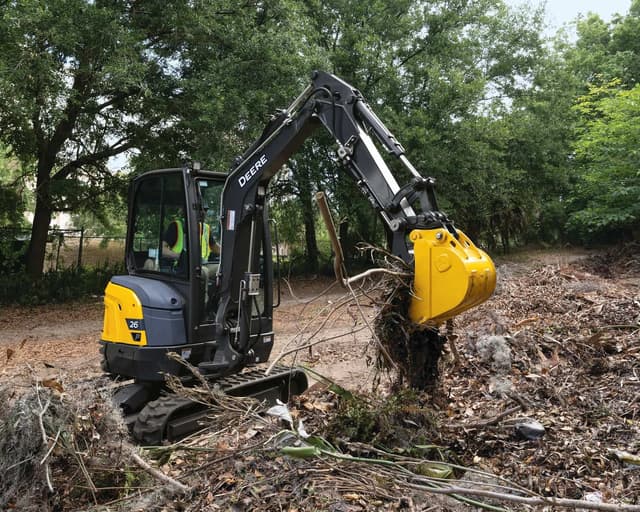
Spring in Mississippi always creates two problems: standing water and utility conflicts. Whether you’re laying a new waterline, cleaning out a drainage ditch, or digging around buried infrastructure, you need a precise machine that won’t compromise power.
The John Deere 26P compact excavator earns its keep in exactly these situations. Read on to learn why it's one of the most practical machines for Mississippi property owners and contractors alike.
Mississippi's clay soils don't move water the way sandier soils do. Spring rains accumulate in low spots, pool near structures, and back up in drainage systems that have collected sediment over winter. If you leave these problems unaddressed, they will become real liabilities to foundations, pastures, and trees.
Building up drainage systems like ditches, culverts, and surface channels is one of the most common spring projects for rural properties in Mississippi during springtime. These are also projects where equipment—and equipment size—matter most. Too small, and you won’t get the job done. Too large, and you’ll cause potential surface or structural damage.
The 26P sits in a practical middle ground. It's compact enough to work in tight spaces and on soft spring ground, but capable enough to handle serious digging in clay-heavy soil.
The 26P puts out 20 horsepower and delivers a digging force of 4,994 pounds. This is more than sufficient to cut through the compacted clay soils common across central and north Mississippi. With a maximum digging depth of 8'6", it handles utility trenching, drainage ditch cleanouts, and culvert installation without being pushed beyond its capacity.
Best For: drainage ditch cleanout and extension, utility line trenching, culvert installation, maneuverability in tight spaces
One of the 26P's most practical features for spring utility and drainage work is its zero tail swing design. The upper structure rotates without extending beyond the undercarriage, meaning you can dig next to a fence line, a building foundation, or a buried utility without repositioning the machine every time you rotate. On Mississippi rural properties where fence lines, tree lines, and structures often sit close together, this isn't a minor convenience. It's what makes the job possible without causing additional damage.
Soil conditions in Mississippi can be challenging for heavier equipment. The 26P's operating weight of 6,110 pounds keeps ground pressure manageable for most spring conditions, and its rubber tracks minimize surface damage in ways that wheeled equipment simply can't match. On established properties like lawns, finished yards, or managed pasture, this makes a huge difference.
The 26P includes auxiliary hydraulics and a quick-coupler system, making attachment changes easy, even in the field. For spring drainage and utility work, the most versatile attachments are:
Factoring attachment costs into your equipment budget from the start makes a significant difference in working capability. A 26P with only a standard bucket limits what you can accomplish. Add a ditching bucket and a hydraulic thumb and you've got a machine that handles most spring drainage and utility scenarios without additional equipment.
If drainage or utility work is on your property calendar, the 26P is worth a serious look. Stop into your local WADE, Inc. to talk through specs, attachments, and financing options. Our team understands Mississippi property conditions and can help you assess whether the 26P is the right size machine for your specific project.
The 26P is purpose-built for utility trenching, drainage ditch cleanout, and culvert installation in tight spaces where larger equipment would cause surface or structural damage. Its zero tail swing design and rubber tracks make it especially practical on established Mississippi properties where fence lines, structures, and soft spring ground are all working against you.
Yes. The 26P delivers a digging force of 4,994 pounds and a maximum digging depth of 8'6", which is more than sufficient to cut through the compacted clay soils common across central and north Mississippi.
A standard bucket alone limits what the 26P can accomplish. For drainage and utility work, the most practical additions are a trenching bucket for narrow utility cuts, a ditching bucket for wider channel work, and a hydraulic thumb for handling rock, roots, and debris.